Firework and storm phobias

Many dogs suffer from firework and storm phobias. Both storms and fireworks are pretty unpredictable, which makes training tricky. Dogs will sometimes do crazy things out of fear: from hiding in the bathroom, through peeing themselves, to running away – and 40-50% of those who did run away never make it back! So our first priority is reducing the amount of fear they experience.

Bear in mind that each dog is different, not all of them can be cured and not all of us have what it takes to go through a rigorous counter-conditioning program. It is vital that we are honest about what we can achieve at the given time and just strive for the best possible scenario.

A dog hiding in the wardrobe.
Many dogs prefer closed, windowless spaces for hiding, for example bathrooms and wardrobes. ©Lis Berger

1. Assess your dog

You need to recognize how stressed your dog is in the given situation1. It will determine how much work there is for you. This is a list of common signs of stress starting with the milder, more ubiquitous symptoms.

    • panting
    • pacing
    • yawning
    • drooling
    • licking (especially paws)
    • vocalizing (whining/barking)
    • attention seeking
    • shedding
    • hiding
    • shaking
    • urinating (this one can go both ways – the dog can urinate out of fear or they may be so stressed that they’re incapable of elimination)
A dog eating cottage cheese.
If your dog is not too stressed, you can give them a toy filled with their favorite food. Chewing and licking at the food can help them calm down. ©Piri Stechauer

2. Ahead of time: decrease the overall stress level

Stress is not a one-off event, it accumulates over time. That means that even if you can’t quickly cure your dog of firework phobia, they will have an easier recovery if they’re overall doing well.

If you know that fireworks will happen or that a storm is approaching you can:

Avoid doing anything that makes your dog scared or uncomfortable (car rides, restaurant visits, the vet…) but also limit high-adrenaline activities such as playing ball. It might also be wise to skip your agility class for a while. Instead go for calm walks in places where you don’t have to control your dog all the time, offer them lots of opportunities to sniff, gentle massages, take them for a swim… you know best what makes your dog go all soft and chill.

Other options include:

  • prescription medication – consult your veterinarian on whether this is an option for you
  • a pheromone collar
  • a thunder shirt
  • anxiety relieving food supplements

3. During the event: manage the situation as best you can

  • walk your dog before the fireworks begin
  • secure your dog either with a safety harness or with a combination of a harness and a collar
  • use a GPS tracker if you have one
  • if your dog has a favourite hiding spot, you can make it extra cozy for them
  • turn on music or house appliances during the fireworks – the noise from outside will be less distinct then
  • provide comfort if your dog asks for it
There is a popular belief that you shouldn’t “fuss” over your dog when they’re anxious. This is partly true – you’re not afraid of fireworks, don’t behave as if you were. But it doesn’t mean that you shouldn’t pet your dog or provide companionship!  However, if they do want physical contact pay attention to its form: do not pet your dog with these short, nervous pats on the head or roughhouse with them. Choose calming forms of contact instead: cuddling together, a gentle massage, slow, long strokes.
A woman cuddling with her dogs.
By all means cuddle with your dog if that’s what they need and ask for! ©Lis Berger

4. Long-term solutions: relaxation training and classic counter-conditioning

According to the study conducted by the research center HundeUni Bern the two most effective methods are relaxation training and counter-conditioning.

Relaxation training can include:

  • teaching them to associate a specific piece of rug or music with relaxation
  • introducing a conditioned relaxation cue – your dog learns to relax on cue
  • rewarding them each time they choose to settle down on their own

The usual method used in dealing with fears is classic counter-conditioning (CCC). Let me quote Jean Donaldson, one of the pioneers of modern day training methods: Counterconditioning is about changing associations. It’s called counterconditioning because the dog already has an unpleasant emotional response [CER] to the thing we’re trying to condition. So we counter that by establishing a pleasant CER2.

For example: your dog hates the vacuum cleaner. Your aim could be to have your dog calmly leave the room when you take out the vacuum cleaner instead of barking at it wildly.

  1. Start with either a recording of the vacuum cleaner or someone can start vacuuming at the other end of the flat3. Your dog decides what is too much.
  2. Pair it with something your dog loves: feed them something delicious, play their favourite game or give them a gentle  massage. Your dog should not show signs of stress!
  3. You gradually increase the intensity of the stimulus until your dog starts liking the vacuum cleaner or at least stops being freaked out by it.
  4. Once they’re not freaked out anymore, you can start working on an alternative behavior, for example resting in another room.

Counter-conditioning might seem easy but it is actually really difficult to plan and execute properly. If you want to help your dog, I’d strongly advise you to work with a competent trainer!

A dog wearing a safety harness.
A dog wearing a safety harness. ©Conny R. Centuri
A dog wearing ear protection.
There is ear protection for dogs (Mutt Muffs) but it’s only good for short periods of time and you must condition your dog to tolerate them! ©Martina Uebersax
a dog wearing a GPS tracker
A dog wearing a GPS tracker. ©Renate Helfert

Are you walking the dog or is the dog walking you?

This topic is important to me because – like so many of us – I walked Leus too much. Then I learned that she has arthritis and had to change my attitude. And then I went to a conference where I heard countless professional dog trainers talk about over-exercising and over-stimulating our dogs. During another conference that I attended there was a whole presentation dedicated to the question of our dogs’ “workload”. Here is what I learned:

Trust your dog. If your dog likes running, they will run a lot. You don’t have to plan extra activities like jogging or dog sports – just provide your dog with the right kind of environment where they can decide if they want to run like crazy or just sniff around.

dog in the bushes at dawn
I like walking Leus in the morning when the world is quiet.

Dog sports (agility, dog cross, flyball etc.) are a bit controversial, some trainers consider them unethical. They argue that dog sports satisfy our needs, not the dogs’ needs. I don’t want to make a blanket statement about all dog sports. However, be aware of the physical toll that high-speed sports can have: all these jumps and rapid turns are not necessarily good for the dogs. If you really want to do dog sports consult a veterinarian first and make sure there are no contraindications (for example German shepherds and bulldogs tend to have congenital hip problems).

Moreover, these high-energy activities also increase adrenaline production – they stress your dog. Stress in itself does not have to be bad but if your dog is already easily (over)excited, this might not be the way to go. You might end up with a very fit, very fidgety dog simply because they can’t bring their stress levels down enough to rest.
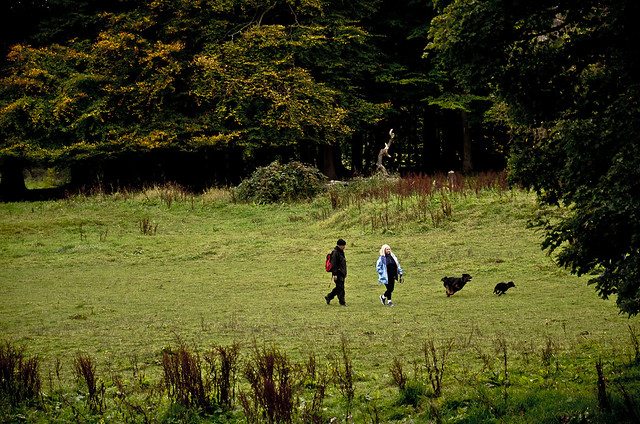
2 people walking 2 dogs in the fields
If your dog has good recall, they can enjoy off-leash privileges.

Playing ball is an example of a beloved activity that should actually be approached with caution. If you (or your dog!) insist on this activity, try re-thinking it:

  • If your dog loves chewing the ball – let them! Just make sure they don’t swallow pieces of it. Chewing also relaxes your dog so it is good if your dog does it.
  • Ask your dog for a stay and hide the ball, then let them sniff it out. It might also be a great alternative for dogs who love playing ball but should not chase after it anymore for health reasons.
  • Don’t make them fetch. Once they understand the principle they will bring the ball back to you if they want to play. I know that watching them chase and fetch is incredibly satisfying, but this is supposed to be about them, not about us.
  • If your dog loves the ball you can use it as a reward in training (for example throw it after a successful recall).

The most important thing is to give your dog choices. The dog training world is buzzing with phrases like “learner empowerment” and “initiating a training conversation”, and for a good reason: research has shown that the more dogs are allowed to make their own decisions and interact with their environment on their own terms, the more self-confident and calm they are. That does not mean that you let your dog do whatever they want all the time. But try to let them choose as much as possible. I mean honestly, does it really matter if you go left or right at that particular intersection in the park?


a park, people on benches, runners, people walking
A busy place full of joggers, people on picnics, children and other dogs can stress out your dog.
empty-ish island shore, city in the background
The less you have to control your dog, the more you can both enjoy the walk. If possible, just pick a less frequented path with fewer distractions.

The sense of smell is another thing we theoretically all know about, but in practice we often fail to acknowledge its relevance. I don’t think there is any way we can imagine what smelling things means to dogs – it has been compared to us reading the news or scrolling social media, which may or may not be close. The fact remains that dogs engage with their environment best through their sense of smell. So let them smell. Imagine if every time you started reading a post on facebook, someone interrupted you. Not very nice, is it?

Which brings me to my last point: take your time when you walk your dog. Remember, the walk is for them, not for you. If your dog doesn’t feel like running that particular morning then let them be. You can still spend that hour outside (if they want to walk at all), just try to refrain from telling them what they should do. Dogs actually get tons of mental stimulation when they sniff and at the same time it has a calming effect (it literally slows down their heartbeat), so after an hour of intense sniffing around your neighbourhood they might be more relaxed than after playing ball.

This does require a change of attitude from walking the dog to walking with the dog. But watching them be happy is, I think, inherently rewarding to all of us and it’s really worth it.

Surviving the summer

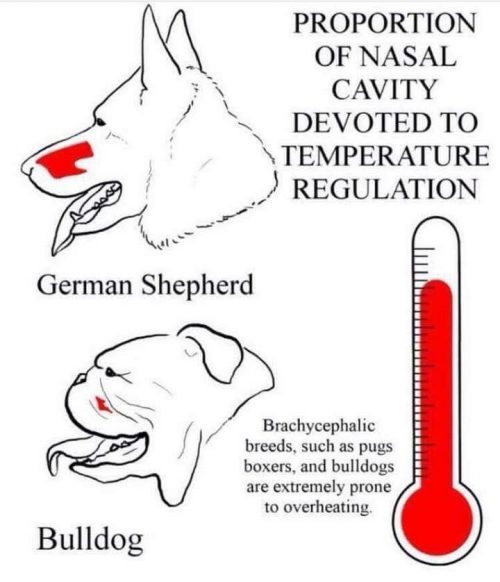
The summer is finally here. For us it may be the time for wearing cool summer clothes and drinking spritzers outside but our dogs might be less happy about it. Firstly, they can only sweat through their paws and their main way of regulating body temperature is panting. Secondly, contrary to popular belief, dogs can also suffer sunburn – especially the ones with short coats. Owners of flat-faced4 dogs such as bulldogs, pugs or boxers must take special care of their furry friends in the summer as they already have trouble breathing under the best conditions.

Short-snouted dogs (pugs, boxers etc.) struggle with breathing at the best of times. Their owners must take special care in the summer.
Source: http://www.balancebehaviour.org

Continue reading “Surviving the summer”

Why I’m not happy that Cesar Millan visits Budapest

Cesar Millan is one of the most famous dog trainers in the world. His TV program “The dog whisperer” ran on the National Geographic channel for 8 years and was only taken down after he was accused of animal cruelty. But I will not go into details about Cesar Millan and his commercial career.

Instead, I would like to provide an alternative, science-based explanation of what is happening in the preview that Cesar Millan did for Index. If any good training is based on setting the dogs up for success, this is clearly an example of bad training because the dogs were set up for failure.

My interpretation5:

  • Two dogs who do not know each other are forced to confront each other frontally6 in a small room full of people.
  • They are both on the leash.
  • They are sliding on the floor.
  • The handlers don’t tell the dogs what they want them to do.

In the beginning both dogs are curious and a little excited. Then you can see a change especially in the vizsla that Cesar is handling: the tail goes down, he looks away, nearly freezes, his mouth is first shut tight, then he starts panting heavily. From a dog that was excited but fine, he turns into a dog that is tense, shows clear signs of stress and uses many calming signals.

If you look at the small dog, it’s actually doing a great job of communicating his preferences, using a lot of calming signals to de-escalate the situation. He clearly attempts to walk away.

There is one more thing that I must mention. It is Cesar’s “training tool” which, according to him, “calms the brain”. BULLSHIT. It is a thin leash that forms a noose at one end. He puts it so that it circles the dog’s muzzle and is fastened where the skull and the neck meet. Even though he talks about how the dogs shouldn’t pull, once the device is placed he applies constant pressure effectively depriving the dog of oxygen. He doesn’t have to apply a lot of force because the laws of physics and nature work in his favor:

  • The smaller the area we apply pressure to, the less strength has to be applied to achieve the desired effect. Put simply the thinner the rope, the easier it is to suffocate the dog.
  • The area where the skull and the neck meet is especially vulnerable, which means that this device is also probably causing pain.

Cesar never stated what the purpose of this exercise is but let’s assume it was to stay by their handler’s side without pulling on the leash. Can dogs do that under such unfavorable circumstances? Yes, they can. BUT YOU MUST TRAIN THEM, not terrorize them.

sad dog
photo: www.pexels.com

Below you can find a small selection of signs exhibited by the vizsla in the video. If anyone is interested in a more detailed analysis that I compiled with the help of dog trainers from the Canis Pacalis network, I would be happy to send it by email:

  • in the beginning of the video the vizsla is pulling on the leash and moving
  • 00:07–00:10 the dog already starts tongue-flicking when Cesar stands very close to him and gesticulates wildly
  • 00:1700:20 when Cesar puts the device on he stands directly in front of the dog and leans over him7, you can see the tail slowing down
  • 00:3200:34 when Cesar holds the leash: the dog is barely moving anymore, the head and tail are low, the whole body seems tense, the ears lean slightly backwards, the dog tries to turn away but can’t
  • 00:5200:59 the dog is barely moving, his tail is low, his mouth is wide open, he pants heavily and his head is facing away from Cesar as much as possible. His panting and wagging speed up when Cesar touches him. When Cesar goes to the back and demonstrates pulling on the leash, the dog freezes.

Do not shout at your dog – pt. 2

Let’s recap: I was walking my dog off leash and talking on the phone. She walked onto a street. I shouted at her to come back, in response she lied down in the middle of the street. Not good. But why? The answer is of course: body language. Let’s have a look.

The human side: what was I doing?

I was standing tall, probably with my arms outstretched to some degree, leaning forward somewhat, using a loud, unpleasant tone of voice. Dogs can learn the meaning of verbal commands, but they’re hard-wired to respond to body language and it’s hard for them to overcome it.

Continue reading “Do not shout at your dog – pt. 2”